
Advertisement
Advertisement
The U.S. Supreme Court this week declined to hear multiple cases that could have reshaped interpretations of workplace religious discrimination and Second Amendment protections, leaving unresolved tensions around faith, free expression, and gun ownership. Among the cases declined was that of Ronald Hittle, a former fire chief in Stockton, California, who alleged that his dismissal had been influenced by bias against his Christian faith. His termination in 2011 followed an internal city investigation that cited issues with management, attendance, and decision-making. Included in the list of alleged violations was his participation, along with other managers, in a faith-based leadership conference conducted during work hours.
Advertisement
It was argued that the Global Leadership Summit, which had been described as a church-sponsored event for Christian leaders, had been attended at the city’s request for professional development purposes. Hittle maintained that this attendance became the primary reason for his dismissal and that his Christian beliefs had been treated as a liability within city administration.
Advertisement
Advertisement
Court filings indicated that Hittle’s legal challenge centered on whether the long-standing precedent in McDonnell Douglas Corp. v. Green (1973), which defines standards for employment discrimination claims, should be revisited to better reflect modern understandings of workplace bias. His attorneys contended that when religious motives are a factor in an employment decision, employers should not be shielded merely because other lawful reasons exist alongside them.
Advertisement
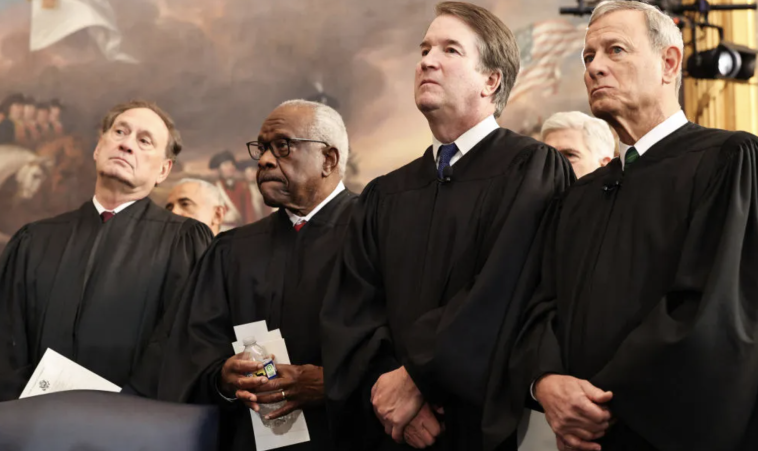
The Supreme Court declined to hear the appeal. However, Justices Clarence Thomas and Neil Gorsuch expressed that the case merited review, emphasizing that Hittle had presented substantial evidence suggesting discriminatory intent. It was suggested that reconsideration of the precedent could have clarified how religious discrimination claims are evaluated under federal law.
Advertisement
Advertisement
The City of Stockton maintained that Hittle’s termination had been fully supported by documented performance issues and that his claims were inconsistent with the evidence presented in lower courts. The Ninth Circuit’s prior ruling upheld the city’s actions as legally justified.
In the same session, the Supreme Court also declined to hear a pair of high-profile Second Amendment cases. One involved Delaware’s restrictions on so-called “assault weapons” and large-capacity magazines, while another challenged Maryland’s licensing requirements for handgun ownership. Both petitions had sought to overturn state-level restrictions that gun rights groups argued were inconsistent with constitutional protections.
Advertisement
Advertisement
By declining to hear those appeals, the justices left intact rulings from lower courts that upheld the state laws. Delaware’s statutes, enacted in 2022, prohibit the sale of specific semi-automatic rifles and restrict magazine capacities above 17 rounds, though previously owned weapons are allowed under limited conditions.
Plaintiffs in both states—including individual gun owners, dealers, and advocacy organizations such as the Firearms Policy Coalition and the Second Amendment Foundation- had argued that the laws represented clear infringements on the right to bear arms.
The Court’s refusal to review the cases has been viewed as a temporary pause rather than a retreat from the conservative majority’s established originalist interpretation of the Second Amendment, which has guided landmark rulings since 2008. Analysts noted that additional petitions concerning Maryland and Rhode Island restrictions remain pending, leaving open the possibility that future rulings could revisit the scope of constitutional gun rights.
Taken together, the Court’s recent decisions reflect a cautious judicial posture, avoiding direct engagement with politically charged disputes over faith in the workplace and firearm ownership, while leaving ongoing debates about religious liberty and individual rights to continue within lower courts and state legislatures.
3 Comments